15 min read
Your business has a website. It looks reasonably good, your services are listed, and your contact details are available.
But there is one problem: it is not bringing you customers.
People visit occasionally, but enquiries are rare. Potential customers browse a few pages and leave. You may even be paying for advertising that sends visitors to your website without generating meaningful business.
So, what is going wrong?
A website is supposed to do more than establish that your business exists online. It should help potential customers understand what you offer, trust your business and take the next step.
When that does not happen, something in the customer journey may be broken.
The problem could be your website's visibility, messaging, design, performance, content or conversion process. And sometimes, several of these issues exist at the same time.
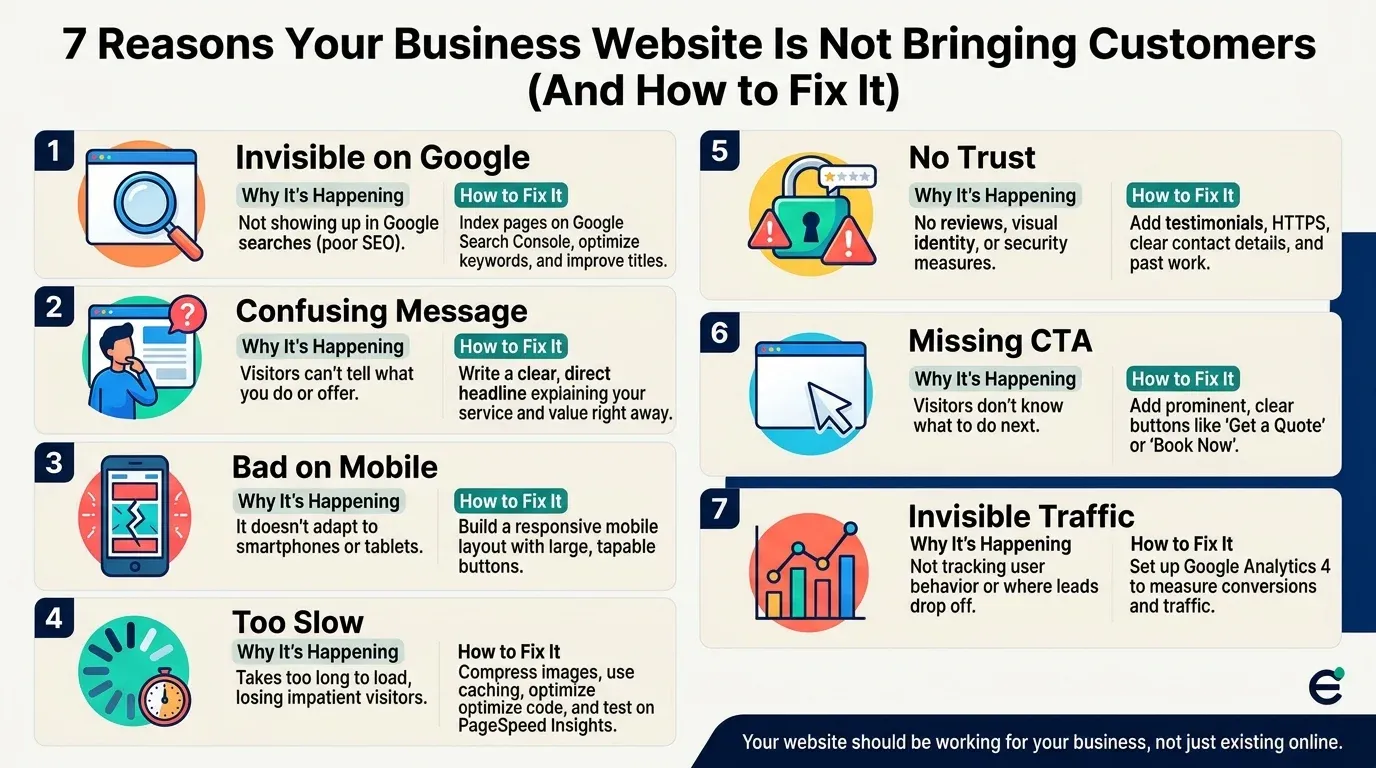
Here are seven reasons your business website may not be bringing you customers, along with practical ways to identify and fix them.
Let's start with the most fundamental problem.
If potential customers cannot find your website, they cannot become customers through it.
Imagine you operate a cleaning company. Someone searches Google for "professional office cleaning services" in your area. Several businesses appear, but yours does not.
You may have an excellent website, competitive prices and experienced staff. Unfortunately, none of that matters to someone who cannot discover your business.
This is where search engine optimisation (SEO) becomes important.
Your website needs to help search engines understand:
Signs this may be your problem:
How to fix it:
Start by checking whether your important pages are indexed using Google Search Console.
Then review your website's SEO foundations:
Do not simply repeat keywords throughout your website. Build pages that genuinely answer what potential customers are looking for.
A website that is invisible to your target audience will struggle to generate enquiries, regardless of how attractive it looks.
Imagine someone opens your homepage and sees:
"Innovative Solutions for a Better Tomorrow."
It sounds impressive, but what does your business actually do?
Do you provide accounting services? Sell electronics? Build software? Offer consultancy?
Your visitors should not have to investigate your entire website to understand what you offer.
One of the biggest website mistakes is prioritising impressive language over clear communication.
Your homepage should quickly answer three questions:
For example, compare these two messages:
Unclear:
"We deliver innovative solutions that empower businesses to achieve excellence."
Clearer:
"We provide professional accounting and tax services for small and growing businesses."
The second message immediately communicates what the business does and who it serves.
Signs this may be your problem:
How to fix it:
Your website may look acceptable on a desktop computer but provide a completely different experience on a smartphone.
This is a serious problem because many potential customers discover and interact with businesses using mobile devices.
Consider someone trying to contact your company while travelling. They open your website, but the text is too small, the navigation is confusing and the contact button is difficult to tap.
What happens next?
They leave and look for another business.
An outdated website can also create concerns about professionalism. Customers may question whether a business that has neglected its online presence is equally careless in how it handles its services.
Signs this may be your problem:
How to fix it:
Your website should be designed and tested for mobile devices, tablets and desktop screens.
Pay attention to:
You can also use Google's PageSpeed Insights to evaluate performance and identify mobile and desktop usability issues.
A professional website should work properly wherever your customers access it.
People expect websites to respond quickly.
If a page takes too long to load, visitors may abandon it before they even see what your business offers.
This becomes especially frustrating when someone clicks an advertisement or a search result because they are already interested in what you provide.
Slow websites can be caused by several factors, including:
Signs this may be your problem:
How to fix it:
Start by testing your website with Google PageSpeed Insights.
Pay particular attention to Google's Core Web Vitals:
| Metric | What it measures | Good target |
|---|---|---|
| Largest Contentful Paint (LCP) | Loading performance | 2.5 seconds or less |
| Interaction to Next Paint (INP) | Responsiveness | 200 milliseconds or less |
| Cumulative Layout Shift (CLS) | Visual stability | 0.1 or less |
These are Google's recommended good thresholds, measured at the 75th percentile of real-user page loads.
Improvements may include compressing images, reducing unnecessary scripts, implementing caching, improving hosting and optimising application code.
Do not focus on achieving a perfect performance score at the expense of functionality. Focus on making the actual customer experience faster and more reliable.
Think about the last time you considered buying something from a business you had never used before.
You probably wanted to know:
Your potential customers have similar questions.
A website that provides little evidence of credibility may struggle to convert visitors, even when the business offers excellent products or services.
Signs this may be your problem:
How to fix it:
Give visitors legitimate reasons to trust your business.
Consider including:
If you have completed projects, show them. If customers have shared positive feedback, use it with their permission.
Never manufacture testimonials, customer numbers, certifications or business achievements.
Trust is built through consistency, transparency and evidence.
This is one of the most overlooked reasons websites fail to generate enquiries.
A visitor arrives, reads about your business, looks at your services and then reaches the bottom of the page.
What should they do next?
If the answer is unclear, you have created unnecessary friction.
Every important page should guide visitors towards an appropriate action.
Depending on your business, that action could be:
A call to action (CTA) makes that next step clear.
Signs this may be your problem:
How to fix it:
Make the next action obvious.
For example:
Place relevant calls to action where visitors are likely to need them.
Also, test your contact forms, telephone links, email addresses and messaging integrations regularly.
A contact button that does not work is worse than having no button at all.
This is where many businesses make expensive marketing decisions.
You may know how many people visit your website, but do you know what they do after arriving?
Do they visit your service pages? Do they click your contact button? Do they submit enquiries? Which pages attract visitors but fail to generate action?
Without this information, you are making decisions based on assumptions.
For example, you might spend more money on advertising because website enquiries are low, when the actual problem is that your landing page does not communicate the offer clearly.
Or perhaps one service page generates most of your enquiries, but you have never considered investing more in promoting it.
Signs this may be your problem:
How to fix it:
Set up measurement tools that help you understand website performance.
Useful options include:
Do not measure success through traffic alone.
For most businesses, meaningful enquiries, qualified leads, bookings and sales matter more than the number of visitors.
A website should be treated as a business asset that can be measured, improved and developed over time.
Let's bring everything together.
Use this quick checklist to assess your website.
| Website problem | What to check |
|---|---|
| Poor Google visibility | Can customers find your important service or product pages? |
| Unclear messaging | Can a first-time visitor understand what you offer within seconds? |
| Poor mobile experience | Does the website work properly on a smartphone? |
| Slow loading | Have you tested your important pages using PageSpeed Insights? |
| Lack of trust | Are your business details, reviews and relevant work clearly presented? |
| Weak calls to action | Can visitors easily contact you or take the next step? |
| No performance tracking | Can you measure enquiries, conversions and traffic sources? |
If you identify several problems, your website may need more than a few visual adjustments.
It may require a proper review of its design, content, technical performance, SEO and conversion process.
The important thing is to identify the actual problems before spending money on a redesign.
Not every underperforming website needs to be replaced.
Sometimes the solution is straightforward: improve the content, fix broken links, optimise images, simplify navigation or improve the contact process.
In other situations, the existing website may have deeper problems.
A redesign or rebuild may be worth considering when:
The right decision depends on the condition of the existing website, the cost of repairs and what your business needs to achieve.
A good website review should identify which improvements are necessary and which are unnecessary expenses.
A business website should have a purpose.
It should help potential customers discover your business, understand your offerings, establish confidence and take meaningful action.
If it is attracting visitors but not generating enquiries, there is a reason worth investigating.
You may not need more advertising. You may not need more social media followers. You may simply need a website that works better for the people visiting it.
At Ezalta Technologies, we help businesses improve their digital presence through professional web development, software solutions and digital platform development.
Our approach is to understand what your business needs, identify the right technology and build solutions that support your objectives.
Whether your existing website needs improvement or you are considering a complete redesign, the first step is understanding what is holding it back.
Let's take a closer look at your website.
Visit Ezalta Technologies or contact our team to discuss your website and the improvements that could make it more effective.
Your website should be working for your business, not just existing online.
A business website may fail to generate customers because it has poor search visibility, unclear messaging, slow loading times, weak mobile usability, insufficient trust signals, confusing calls to action or no conversion tracking. Identifying the specific problem is the first step towards improving results.
Evaluate your website using relevant indicators such as organic search traffic, qualified enquiries, conversion rates, mobile usability, page performance and customer engagement. Google Analytics 4 and Google Search Console can help you understand different aspects of performance.
No. Visual design contributes to the customer experience, but it does not guarantee enquiries or sales. A successful business website also needs clear messaging, relevant content, search visibility, good performance, credibility and effective conversion paths.
Make your services clear, improve relevant landing pages, provide genuine trust signals, simplify contact options, add clear calls to action and measure important customer actions. You should also ensure your website reaches the right audience through SEO and relevant marketing channels.
Website performance and Core Web Vitals are part of Google's page experience considerations. However, good Core Web Vitals scores do not guarantee high rankings. Content relevance, usefulness and many other factors also matter.
Not necessarily. Some websites need targeted improvements rather than a complete rebuild. Review the website's structure, content, performance, search visibility and conversion process first. A redesign is worth considering when the existing platform cannot adequately support your business needs.
The cost depends on the website's condition, complexity, functionality and required improvements. Fixing a few technical or content issues may be relatively straightforward, while rebuilding a website or introducing e-commerce functionality requires a larger project scope. A proper assessment helps determine the most appropriate investment.
Yes. Ezalta Technologies provides web development, software development and digital technology services. You can contact the team to discuss your existing website, identify improvement opportunities and determine the appropriate next steps.
Your website is often one of the first places potential customers evaluate your business. Make sure it gives them a reason to stay, trust you and get in touch.